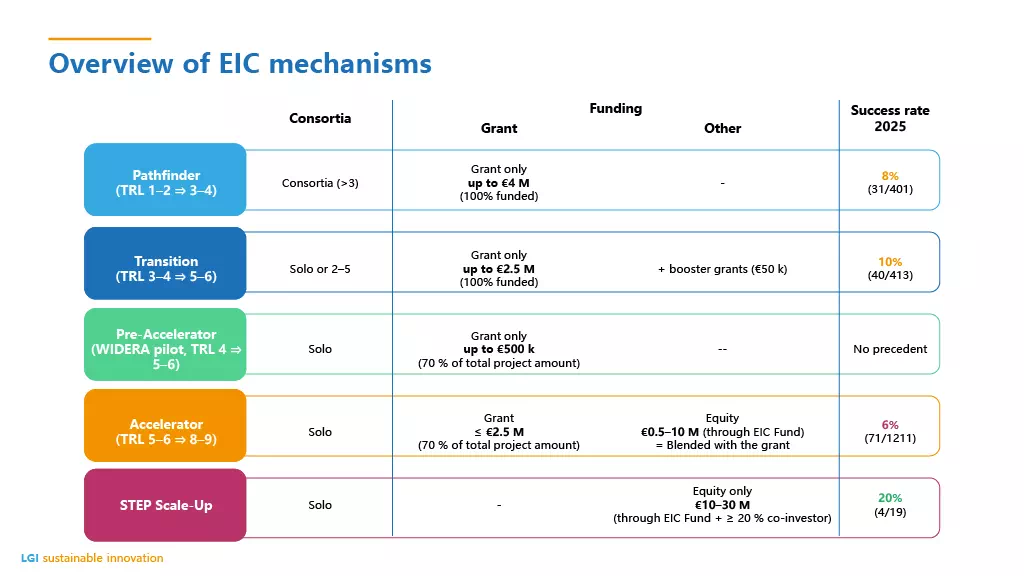
If you’ve taken a look at the 2026 work programme and are considering applying, you know you are entering one of the most competitive funding landscapes in Europe. In 2025 success rates sat between 6% and 20%. The gap between a "high-quality" proposal and a "funded" one usually comes down to one thing: Strategic Readiness.
Beyond a traditional research grant, EIC sets up a roadmap for scaling deep tech into global markets. The question is: Is your innovation ready for evaluation, investment, and scale?
The EIC is structured around maturity stages. Pathfinder, Transition, Pre-Accelerator, Accelerator and STEP Scale-Up they correspond to different phases of the same innovation trajectory.
- Pathfinder supports early-stage, high-risk research and proof of principle.
- Transition bridges validated research and application-driven development.
- Pre-Accelerator helps promising early-stage teams to strengthen business and investment readiness before entering the Accelerator.
- Accelerator supports commercialization and scaling of deep tech companies.
- STEP Scale-Up focuses on large-scale equity investment for strategic technologies.
Across all schemes, the logic is to: reduce risk, validate assumptions, structure impact, and demonstrate credible scaling potential. Understanding this can help you position your project more effectively.
The Five Dimensions of EIC Readiness
Regardless of the scheme, evaluators are looking for a cohesive story across five pillars. If one is weak, the whole proposal collapses.
Technological Readiness
It’s about a credible path to move it forward. Overstating the technology readiness level (TRL) is the fastest way to lose an evaluator’s trust.
Is the technology genuinely at the claimed TRL? Are validation steps clear, measurable? Does the proposed work logically advance maturity?
Business Readiness
Even at the Pathfinder stage, you need to show you’ve thought about IP strategy and use cases. By the Accelerator stage, your revenue logic needs to be flawless.
Have you clearly defined application use cases? Can you clearly articulate why your solution will win against existing and emerging alternatives? Is your innovation protected in a way that secures long-term competitive advantage? Do you have a realistic route to market? Is your revenue model aligned with your market dynamics?
Impact Readiness
The EIC is funding European competitiveness. How does your project contribute to strategic autonomy? Is there a clear societal or environmental relevance?
Projects with strong science but weak impact rarely score highly enough.
Investment readiness
Especially in Accelerator and STEP Scale-up, the proposal must withstand investor-level scrutiny.
Are you bankable? This includes clear risk identification (technical, market, regulatory, financial), Logical de-risking strategy, capital strategy and even evidence that public support will unlock additional private investment
Execution Readiness
Ambition must match operational capacity, in other words: does the team have what it takes to pull it off? Are governance and decision-making structures credible? Is the consortium composition aligned with objectives? Are resources allocated realistically?
A Structured Approach to EIC Preparation
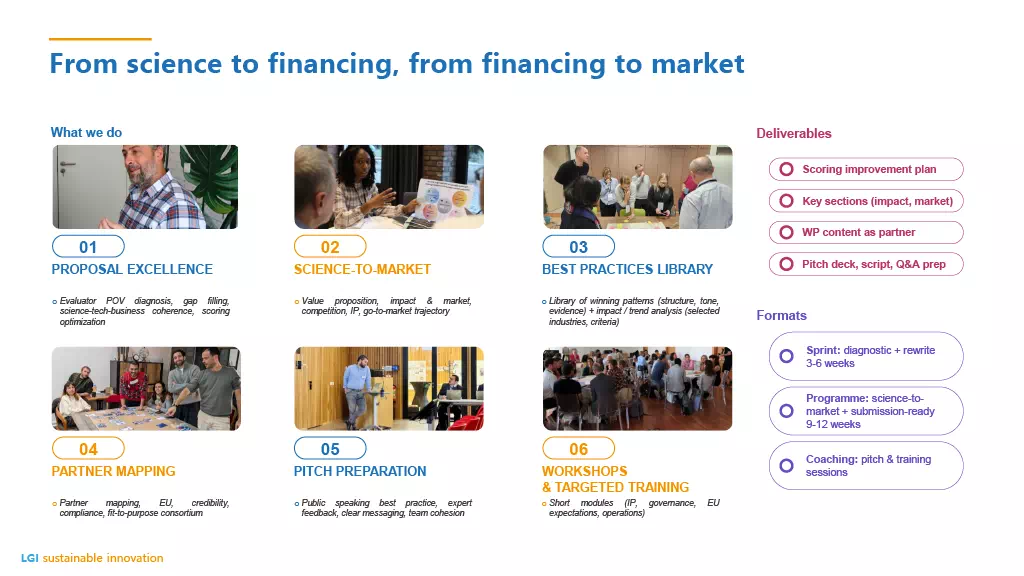
At LGI, we don't believe in "one size fits all" templates. In an increasingly competitive landscape, we understand your technology and ambition; we call our experts, and we provide a real sounding board. Working with us means tapping into two decades of EU project leadership and a Science-to-Market ecosystem that lasts beyond the grant.
Your Innovation deserves to fly. Let's fly it together
Your EIC experts
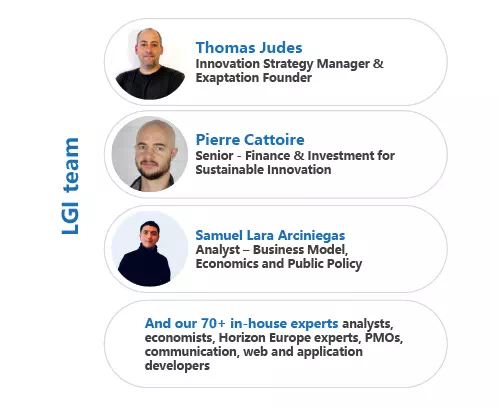
@ Thomas Judes - Senior Manager & Exaptation Founder
@ Pierre Cattoire - Senior - Finance & Investment for Sustainable Innovation
@ Samuel Lara - Analyst, Business Model, Economics and Public Policy
Get in touch : pierre.cattoire@lgi.earth